
From the Sensex pack, Tata Consultancy Services, Mahindra & Mahindra, ICICI Bank, Maruti Suzuki India, Power Grid, Axis Bank and Adani Ports & Special Economic Zones were among the laggards. On the other hand, HCL Technologies, Tech Mahindra, JSW Steel, Hindustan Unilever, Infosys and Titan were among the gainers.

The company sold 1,97,685 units of Dzire in 2013-14 fiscal.
The company sold 1,97,685 units of Dzire in 2013-14 fiscal.

Maruti, which is majority owned by Suzuki Motors of Japan, pays massive tax, generates huge employment (its staff are almost entirely Indians) and also makes its investors extremely rich. JLR, on the other hand, though owned by Tata has its factories in England and China and in every way (sales, employment, technology) has nothing Indian about it.

These risks would be significantly reduced if the cars had to comply with the UN test regulation for frontal and side impact.
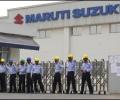
The sacked workers have constituted a seven-member provisional working committee.

Toyota, General Motors, Volkswagen, Ford, Honda, Renault, Hyundai, Suzuki and Nissan are among those who boast of production of a million unit or more every year.

MSI launched the Alto in September 2000. The company then introduced a 1,000-cc version of the car, the Alto K10, in August 2010.
Maruti Suzuki India is gearing up to introduce by the end of this year a new 800cc car that is likely to be more fuel efficient, but also more expensive, than its existing best selling model Alto.

Maruti Suzuki fears a drop in demand for the auto sector in FY 12

Maruti Suzuki India is eyeing a leadership position in the SUV segment as it continues to add new products across various sub segments, a top company official said on Wednesday. The country's largest carmaker has bolstered its presence in the high volume entry and mid level SUV segments with new Brezza and all new model -- Grand Vitara. "In every segment except SUV, we are the market leader by a distance. "It is only in the SUV that we are behind, so we need to catch up. Clearly, we have to become number one in the SUV space also," Maruti Suzuki India MD and CEO Hisashi Takeuchi said in an interaction on the sidelines of the global unveiling of Grand Vitara.

Named ConceptFutureS, it is a uniquely styled compact car with distinct SUV like characters and will define the next generation of design for compact vehicles in India, the company said.
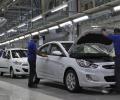
Leading automakers Maruti Suzuki, Hyundai and Tata Motors on Friday reported robust sales for February as demand for sports utility vehicles continued to remain strong. Mahindra & Mahindra, Toyota Kirloskar Motor and Honda Cars also witnessed higher vehicle dispatches to dealers last month. February turned out to be the third-best month for sales for the industry ever.

The 14-day-long strike at Maruti Suzuki India's Manesar's plant has been called off this morning following a tripartite agreement between the management, workers and the Haryana government.
Rolled out in a fleet of four, which comprises three petrol variants along with a CNG counterpart, the freshly redesigned Wagon R has much more than just an exterior upgrade to offer its buyers.

The company has in the meantime said the plant will remain closed.

With nearly 100 launches and unveils, the Bharat Mobility Global Expo 2025, held in Delhi from January 17 to 22, made one thing clear to automobile enthusiasts: Electric vehicles (EVs) are the way ahead for the Indian auto market for years to come.
The firm has suffered production loss of about 1,200 units, valued at around Rs 60 crore.
Hyundai's Grand i10 is a direct challenge to the Swift in the premium compact segment. Is it capable of dislodging the long-reigning Maruti Suzuki car from the top perch?
The model will get new upholstery and audio system.

While saying money was due from Suzuki, the HC told the tax department to determine an appropriate arm's-length pricing mechanism in this case.

Maruti Suzuki India (MSI) and Hyundai posted single-digit growth in domestic sales in June, even as the overall passenger vehicle segment crossed the 20 lakh units sales mark for the first time-ever in the first half this year. Toyota Kirloskar Motor reported a double-digit growth in dispatches to dealers, while Kia saw a dip in wholesales last month. MG Motor India also reported a double-digit increase in retail sales in June 2023 compared to the same month last year.

The other four models introduced with the alternative fuel option are compact cars Estilo and WagonR, multi-purpose vehicle Eeco and mid-sized sedan SX4.

Maruti Suzuki, Hyundai and Tata Motors reported their highest-ever dispatches to dealers last fiscal, enabling the domestic passenger vehicle industry to log in best-ever performance to date. The country's largest carmaker Maruti Suzuki India reported its highest wholesales to date at 19,66,164 units, up 19 per cent from 16,52,653 units in 2021-22. Its domestic dispatches rose to 17,06,831 units in 2022-23, up 21 per cent from 14,14,277 units in 2021-22 fiscal.Hyundai Motor India said its overall wholesales last fiscal were the highest ever since commencing operations in the country.
Maruti Suzuki, the market leader famous for cost effective management in its products, will face the French carmaker.

From the Sensex stocks, Maruti Suzuki India, Tata Motors, JSW Steel, Larsen & Toubro, Tata Steel, Mahindra and Mahindra, Tata Consultancy Services, Tech Mahindra, HCL Technologies and Infosys were the laggards. HDFC Bank, Sun Pharmaceuticals, Kotak Mahindra Bank, Nestle India and Asian Paints were among the gainers.
The petrol variant of the Celerio VXi is available for Rs 4.06 lakh (ex-showroom Delhi).
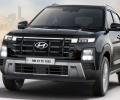
Hyundai Motor India and Honda Cars India on Wednesday joined the list of automakers planning to hike prices of vehicles from April, second time this year, to partially offset the impact of rising input costs and higher operational expenses. In a statement Hyundai Motor India Ltd (HMIL) said it will hike prices of its vehicles by up to 3 per cent effective in April 2025.
Good conduct bonds and contract workers won't help.
While retrenchment of workers is possible under the Industrial Disputes Act, subject to the approval of the state government, dismissal is possible under the Industrial Employment Standing Orders Act, which does not require the state approval.
Three models from Maruti Suzuki, as well as models from Mahindra-Renault, Chevrolet, Toyota and Honda have got top rankings in their respective segments in a survey for new-vehicle design and performance in India, according to J D Power Asia Pacific 2007 India Automatic Performance, Execution and Layout Study (APEAL) released on Wednesday.

The company had sold 50 units of SX4 sedan in August 2014.

While the country's largest car maker, Maruti Suzuki India, said its car will become costly by two per cent, Hyundai Motor India said it will result in a price rise of Rs 6,500-25,000 on average.
Despite the current economic slowdown in the auto industry, the country's largest car maker, Maruti Suzuki India on Thursday said it will hire around 700 people in various departments in the next fiscal, even as it has raised its headcount by 745 in the current fiscal itself.
President Droupadi Murmu on Saturday approved 139 Padma awards including seven Padma Vibhushans, 19 Padma Bhushans and 113 Padma Shris.

Passenger vehicle wholesales saw a marginal growth of 4 per cent in June on account of high base effect and muted demand due to severe heatwave conditions in several parts of the country. Overall passenger vehicle dispatches last month stood at 340,784 units, a growth of 3.67 per cent compared with 328,710 units in June 2023.
The programme was initially launched by O Suzuki, chairman and chief executive officer, Suzuki Motor Corporation in Japan about a month back and has been replicated in the Indian operations as well. Each Maruti car has around 10,000 components and subcomponents that can be classified into 1500 categories.
Maruti has trained 450,000 people in seven years and plans to train 800,000 people in the next three years at its ITDRs, to be set up in other states. Within a year, one ITDR each will be opened in Bahadurgarh, Rohtak, Dehradun and Vadodara. The company will sign soon a memorandum of understanding with the Bihar and West Bengal governments to set up similar projects.

The board of Maruti Suzuki India (MSIL) on Tuesday approved a proposal to issue shares worth Rs 12,841 crore to parent company Suzuki Motor Corporation (SMC) for acquiring Suzuki Motor Gujarat (SMG). The Gujarat manufacturing plant - with an annual capacity of 750,000 units - is owned by SMG, a wholly-owned subsidiary of SMC. The shares issued to SMC will raise its ownership in MSIL from 56.48 per cent to 58.19 per cent--India's largest carmaker stated in a notice to BSE.

Hyundai Motor India Ltd has become the country's fifth most valuable auto firm by market valuation in its debut trade on Tuesday. Shares of Hyundai Motor India Ltd, the Indian arm of South Korean automaker Hyundai, listed at Rs 1,931, reflecting a decline of 1.47 per cent against the issue price of Rs 1,960 on the BSE earlier in the day. The stock slumped 7.80 per cent to Rs 1,807.05 during the day and finally ended at Rs 1,820.40 apiece, down 7.12 per cent.
